

Why look back now
Every November the country stops for two minutes to remember the people who served and died in the two World Wars and the conflicts since. It is right that the focus is on them. But it is also worth remembering how those wars changed everyday working life for everyone who came after, because the changes were enormous and many of them are still with us.
Before 1914, finding work in Britain was a largely informal business. People heard about jobs through family, friends, chapels, pubs, newspaper columns and the factory gate. The state played a small part. By 1945 the government had registered almost the entire adult population, told millions of people where they could and could not work, conscripted women as well as men, and pioneered selection methods that are still used in assessment centres today.
This article looks at how that happened, what worked, what went badly wrong, and what employers today can still learn from it. The figures quoted come from official reports of the time and from the work of institutions such as the Imperial War Museums, the National Archives, the National Army Museum and the UK Parliament, all of which are listed at the end.
Britain in 1914: a small army and an informal labour market
When Britain declared war on Germany on 4th August 1914, it had the smallest army of any of the major European powers. The regular army numbered around 250,000 men, supported by reservists and the part time Territorial Force, and many of those regulars were stationed across the Empire. Germany and France could each mobilise millions of conscripts within weeks. Britain had never had conscription in peacetime and had no plans to introduce it.
The civilian labour market was not much better organised. Labour exchanges had only existed since 1st February 1910, set up under the Labour Exchanges Act 1909 that Winston Churchill steered through as President of the Board of Trade, with William Beveridge doing much of the detailed design. They were still finding their feet, and most employers continued to hire the way they always had. There was no national record of who did what job, where skilled workers lived or which industries could spare people.
That mattered, because the war that began in 1914 would need far more than soldiers. It would need shells, ships, uniforms, coal, food and transport on a scale nobody had planned for, and every person who went to the front left a gap somewhere at home.
Kitchener’s call and the volunteer surge
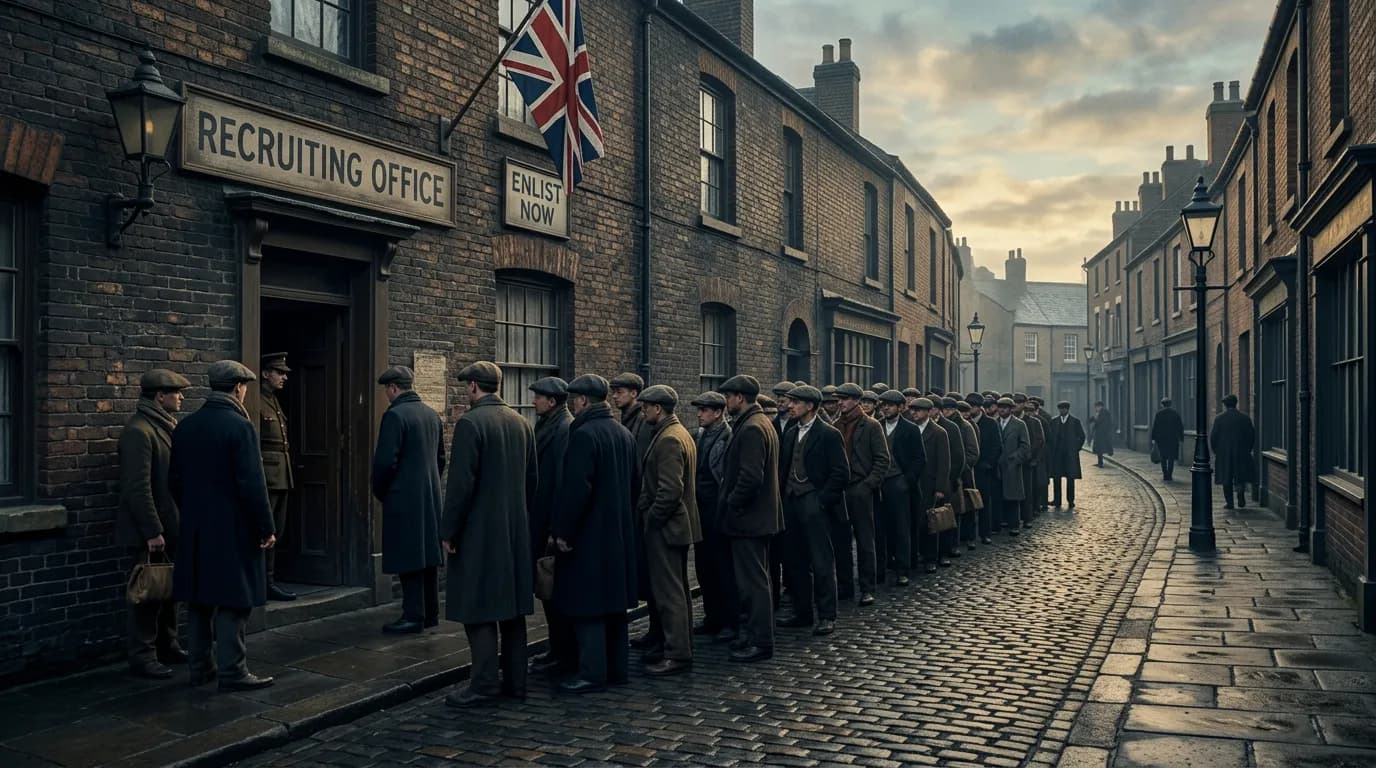
Lord Kitchener was appointed Secretary of State for War on 5th August 1914. Unlike many in government, he expected a long war, and on 7th August he appealed for the first 100,000 volunteers aged between 19 and 30. That target was passed within about a fortnight. On 3rd September 1914 alone, 33,204 men enlisted, the highest single day of recruitment of the entire war. By the end of September more than 750,000 men had joined up, and by January 1915 the figure had passed 1 million.
The image most people associate with this period is Alfred Leete’s drawing of Kitchener pointing out at the viewer above the words “Your Country Needs You”. It first appeared on the cover of the magazine London Opinion on 5th September 1914. Interestingly, the historian James Taylor has argued that this design was far less common as an official poster than popular memory suggests, and that by the time it circulated widely the great rush to enlist was already under way. The real recruiting engine was the Parliamentary Recruiting Committee, formed at the end of August 1914, which organised public meetings, speeches, leaflets and a huge range of posters across the country.
It is worth pausing on what this was in recruitment terms. It was the largest employer branding campaign the country had ever seen. It sold a purpose, appealed to identity and used social pressure very deliberately. Some of the posters were aimed not at the men themselves but at their wives, mothers and employers. Some of that pressure was ugly. The handing of white feathers to men in civilian clothes, as a mark of cowardice, caused real distress, sometimes to men who had already served, been wounded or were doing vital work at home.
Volunteering was also uneven. Men in some industries rushed to join while others hung back, and nobody was keeping track of the effect on the economy. Skilled engineers, miners and shipbuilders enlisted in large numbers, which left factories and pits short of exactly the people the war effort would soon need most. It was an early lesson in something every workforce planner knows today: recruiting enthusiastically without a plan can leave you with the wrong people in the wrong places.
The Pals battalions: recruiting through belonging
One of the most effective recruiting ideas of the war came from Lord Derby in Liverpool. At the end of August 1914 he suggested that men who worked or lived together should be allowed to enlist together and serve side by side. Within days Liverpool had enough volunteers for several battalions, and the idea spread quickly. Towns and cities across the country raised Pals battalions from local streets, workplaces, football clubs and professions, with names such as the Accrington Pals, the Grimsby Chums and the Glasgow Tramways Battalion.
From a recruitment point of view, the appeal is easy to understand. People join people. A man who might hesitate to sign up alone was far more likely to do so alongside his workmates and neighbours. The approach drew on trust, belonging and shared identity, which are still some of the most powerful reasons anyone accepts a job.
The cost of it was terrible. Because Pals battalions drew their men from the same small communities, heavy losses in a single action could devastate a whole town. On 1st July 1916, the first day of the Battle of the Somme, the British Army suffered 57,470 casualties, including 19,240 men killed. Of the roughly 720 men of the Accrington Pals who went into action that morning, 584 were killed, wounded or missing. Streets lost their fathers, sons and brothers on the same day, and the army moved away from local recruitment afterwards. It is a sobering reminder that a recruiting method can be effective and still carry consequences that nobody fully thought through.
Who was turned away: health, height and age
Not everyone who volunteered was accepted, and the reasons tell us a lot about Britain at the time. Concerns about the health of the working population were not new. Worries about how many volunteers had been rejected as unfit during the Boer War had already led to the Inter-Departmental Committee on Physical Deterioration in 1904. The First World War brought the problem into the open on a national scale.
The army’s minimum height in August 1914 was 5ft 3in, and in September it was briefly raised to 5ft 6in to slow the flood of recruits. That shut out many fit, strong men, particularly from mining and industrial areas, who had simply grown up shorter because of poor diet and hard childhoods. The answer was the bantam battalions, the first of which was raised in Birkenhead in late 1914 for men between 5ft and 5ft 3in. Thousands came forward. It was, in effect, an early example of questioning whether an entry requirement measured what it was meant to measure.
Age was handled far less carefully. Men had to be 18 to enlist and 19 to serve overseas, but checks were loose and recruiting officers were often paid per recruit. The historian Richard van Emden has estimated that around 250,000 boys under the legal age served in the British Army during the war, some as young as 14.
The fullest picture of the nation’s health came later, from the National Service Medical Boards that examined men of military age in 1917 and 1918. Their report concluded that of every nine men examined, three were perfectly fit and healthy, two were on a definitely infirm level of health and strength, three were incapable of more than very moderate physical exertion, and one was a chronic invalid. It shocked the government and fed directly into the political drive for better housing, public health and welfare that followed the war. Employers today talk about wellbeing as a benefit. A century ago the state discovered, through recruitment, that the health of the workforce was a matter of national survival.
From volunteers to conscription
By 1915 the flow of volunteers was slowing while losses were rising, and the government needed a clearer view of who was available. The National Registration Act of July 1915 required everyone aged between 15 and 65 to register their details, including their occupation, on 15th August 1915. For the first time, Britain had something close to a national skills register.
In October 1915 came the Derby Scheme, under which men could attest their willingness to serve and be called up later in groups, with single men to go before married men. It was a last attempt to make voluntary recruitment work, and it fell short. The Military Service Act followed in January 1916 and came into force on 2nd March, making single men and childless widowers aged 18 to 41 liable for service. In May 1916 it was extended to married men.
Conscription brought with it a system for deciding who should not go. Around 2,000 local Military Service Tribunals heard applications for exemption, and the great majority of cases were about work and family rather than conscience. A farmer might argue that his son was needed for the harvest, or an employer that a particular engineer could not be replaced. Around 16,000 men registered as conscientious objectors, and many of them faced harsh treatment, including prison.
Alongside this, the idea of protected or reserved work began to take shape. Men in key industries could be given badges to show they were on war service, partly to protect them from the white feather campaigners. It was a crude early version of the reserved occupations system that would be planned far more carefully in the next war.
The home front: munitions, dilution and women at work
In May 1915 the Shell Crisis, a public row over the shortage of artillery shells at the front, brought down the Liberal government and led to the creation of the Ministry of Munitions under David Lloyd George. Producing weapons on the scale needed meant finding hundreds of thousands of new workers very quickly, and it meant changing the rules about who could do skilled work.
Under the Treasury Agreement of March 1915, the main trade unions agreed to accept dilution for the duration of the war. Dilution meant breaking skilled jobs down into simpler tasks that could be done by less experienced workers, very often women. The Munitions of War Act 1915 went further. It restricted strikes in munitions work and introduced leaving certificates, which meant a munitions worker could not take another job without their employer’s permission. The certificates were deeply resented and were abolished in 1917 after a wave of strikes.
Women moved into paid work on a scale nobody had seen before. The number of women in employment is estimated to have risen from around 5.9 million in 1914 to around 7.3 million by 1918, and by the end of the war around 950,000 women were working in munitions. They also worked on the railways and trams, in offices, banks, the land and the police, and from 1917 in the new women’s auxiliary services. The work was often dangerous. Munitions workers handling TNT were nicknamed canaries because the chemicals turned their skin yellow, and explosions such as the one at Silvertown in East London in January 1917 killed workers and local residents.
The government also took a much bigger role in running the labour market. The Ministry of Labour was created in December 1916, taking over the labour exchanges and giving the state a permanent department dedicated to employment for the first time.
After 1918: a mixed legacy
Peace brought a sharp reversal for many women. The Restoration of Pre-War Practices Act 1919 required employers to restore the working practices that had existed before dilution, which in practice pushed many women out of the skilled jobs they had done throughout the war. Some of the gains held. Women over 30 who met a property qualification won the vote in 1918, and the Sex Disqualification (Removal) Act 1919 opened the professions, including the law, to women.
Returning servicemen faced their own struggle. Around 41,000 British servicemen had lost limbs, and many more lived with injuries to the body and mind. In 1919 the government launched the King’s National Roll Scheme, which encouraged employers to commit to disabled ex-servicemen making up at least 5% of their workforce. It was voluntary, and take-up was patchy, but it was the first serious attempt in Britain to use employers to support disabled people into work. When the economy slumped in the early 1920s, many of those who had been promised homes fit for heroes found themselves out of work.
1939: planning before the fighting began
The biggest difference between 1914 and 1939 is that this time Britain planned ahead. Officials had studied the damage done by unplanned volunteering, and a Schedule of Reserved Occupations was drawn up in 1938 and published in January 1939. It listed jobs considered essential to the war effort, often with age limits, so that people doing them would not be called up. Engineers, dockers, miners, farmers, scientists and many others were protected from the start.
Conscription also came before the war rather than 2 years into it. The Military Training Act of May 1939 called up men aged 20 and 21 for training, and on 3rd September 1939, the day war was declared, the National Service (Armed Forces) Act made men aged 18 to 41 liable for service. Registration was organised by age group, so call-ups could be staged and matched to what the forces and industry needed.
The aim, in modern language, was workforce planning. Instead of letting individual choices decide where people ended up, the government tried to look at the whole country’s labour supply and allocate it deliberately.
Bevin and the managed labour market
When Winston Churchill formed his coalition government in May 1940, he appointed the trade union leader Ernest Bevin as Minister of Labour and National Service. Within days, the Emergency Powers (Defence) Act 1940 gave the government sweeping powers, and Bevin was able to direct almost anyone into any work the war required. He used those powers carefully, preferring persuasion and agreement with unions and employers, but the powers were there.
The Essential Work Order of March 1941 is one of the most interesting pieces of employment policy in British history. In firms doing essential work, employees could not leave and employers could not dismiss them without permission from a National Service Officer. In return, those employers had to meet standards on pay, training and welfare, such as canteens and medical provision. It was a trade-off. The state took away workers’ freedom to move, and in exchange it raised the floor on how they were treated.
Women were brought into the plan far more systematically than in the First World War. From 1941 women were required to register for employment, and in December 1941 the National Service (No. 2) Act made unmarried women and childless widows aged 20 to 30 liable for conscription. Britain is widely described as the first country to conscript women. They could choose between the auxiliary forces, civil defence and essential industry. According to the Imperial War Museums, by 1943 almost 90% of single women and 80% of married women were employed in essential work for the war effort. The Women’s Land Army reached around 80,000 members at its peak in 1943.
Keeping women in work meant changing work itself. The government encouraged part time shifts so that married women could combine jobs with running a home, and more than 1,000 wartime nurseries were opened so that mothers could work. Flexible working and childcare support, which many employers still treat as modern ideas, were being used at scale more than 80 years ago because the country could not function without them.
Coal shows how far the state was willing to go. By 1943 the mines were badly short of men, many of whom had joined the forces early in the war. From December 1943, one in ten young men called up for national service was chosen by ballot and sent down the pits instead of into uniform. Nearly 48,000 of these Bevin Boys worked in the mines, and many felt for decades afterwards that their contribution had been overlooked. They were only formally recognised with a commemorative badge in 2008.
Selection becomes a science
If there is one wartime change that every recruiter today should know about, it is the War Office Selection Board. Early in the Second World War, officers were chosen largely through short interviews with senior officers. The process tended to favour candidates who looked and sounded like the officers already in post, usually men from public schools, and too many of those selected went on to fail at officer training. At the same time, the army needed far more officers than its traditional pool could supply.
From 1942, War Office Selection Boards replaced that approach. Candidates spent several days being assessed by a team that included military officers, psychiatrists and psychologists. They sat written intelligence tests, took part in interviews, and worked through practical group exercises, including leaderless group tasks developed by the psychiatrists Wilfred Bion and John Rickman, in which no one was put in charge and the assessors watched who stepped forward, who supported others and who held the group together. Rather than judging background and bearing, the boards tried to judge what a person actually did under pressure.
The results were striking. Failure rates at officer training fell, and because candidates saw the process as fairer, more men from ordinary backgrounds came forward to be considered. The army also set up the General Service Corps in 1942, under which new recruits spent their first weeks being tested and assessed before being allocated to the part of the army that best matched their abilities, rather than being placed more or less at random.
The idea outlived the war. The Civil Service Selection Board was set up in 1945 using the same methods, and the approach spread to the private sector, most famously through the AT&T Management Progress Study in the United States in the 1950s. When a graduate today spends a day at an assessment centre doing group exercises, case studies, psychometric tests and interviews in front of several assessors, they are taking part in a process with its roots in the War Office Selection Boards.
1944 and beyond: the modern employer takes shape
Even before the war ended, Britain was rebuilding the rules of work. The Beveridge Report of December 1942 set out the plan for the welfare state, and full employment became an aim of government policy. The Reinstatement in Civil Employment Act 1944 gave returning servicemen and women a legal right to get their pre-war jobs back, a lesson learned from the hardship of the 1920s.
The Disabled Persons (Employment) Act 1944 went much further than the King’s National Roll. It created a register of disabled people and required employers with 20 or more staff to make sure that at least 3% of their workforce were registered disabled people. Remploy was set up in 1945 to provide work for disabled people. The quota system was never strictly enforced and was eventually replaced by the Disability Discrimination Act 1995, but it established the principle that employers had a duty to include disabled people.
Equal pay was raised but not settled. A Royal Commission on Equal Pay sat from 1944 to 1946, and it took until the Equal Pay Act 1970, prompted in part by the Ford sewing machinists’ strike at Dagenham in 1968, for the law to change. National Service carried on in peacetime, with the last men called up in 1960 and the final national servicemen leaving in 1963.
The labour shortages that followed the war also changed who Britain recruited. Workers came from across Europe and the Commonwealth, and the arrival of the Empire Windrush at Tilbury in June 1948 has become a symbol of the many people from the Caribbean who came to help rebuild the country, often recruited directly by public services such as London Transport and the new National Health Service.
What modern hiring still owes the wars
It would be wrong to romanticise any of this. Wartime recruitment involved coercion, propaganda, terrible losses and real injustice. But the people who ran it were dealing with problems that every employer still recognises, and some of their answers have lasted for good reason.
The first lesson is that planning beats enthusiasm. In 1914 Britain let skilled workers rush to enlist and then spent years trying to get them back. In 1939 it decided in advance which roles were critical. Any business that loses its best engineer, accountant or account manager because nobody thought about succession is repeating the mistake of 1914 on a smaller scale.
The second is that entry requirements should be tested against reality. The bantam battalions proved that a height rule was keeping out capable men. Many modern requirements, such as insisting on a degree for a role that does not need one, deserve the same scrutiny. Skills based hiring is, in part, a return to that wartime question of what a job actually demands.
The third is that structured assessment is fairer and more accurate than gut feel. The War Office Selection Boards were introduced because informal interviews kept selecting the same type of person and too many of them failed. Decades of research since have backed that up, consistently finding that structured interviews and work sample tests predict job performance better than unstructured conversations.
The fourth is that widening the talent pool works. Twice in 30 years, Britain discovered that women could do almost every job that had been reserved for men, and that disabled people could make a full contribution when the conditions were right. Flexible hours and childcare were not perks. They were the practical measures that made it possible.
The last is that how you treat people while you recruit them stays with them. The bitterness of the Bevin Boys who felt forgotten, and of the disabled veterans of the 1920s who were promised much and given little, is a reminder that the promises made during recruitment are remembered long after the campaign is over.
Remembering
Remembrance is first and always about the people who died. Around 880,000 men from the British armed forces were killed in the First World War, roughly one in every eight who served. In the Second World War around 384,000 British servicemen and women lost their lives, and more than 60,000 civilians were killed at home, most of them in air raids on places such as London, Coventry, Liverpool, Hull, Plymouth and Clydebank. It is easy for figures like these to become abstract. Each one was a person whose name had once been written on an attestation form, a payroll or a factory clock card, and who left behind a family waiting for news.
The way we remember them was shaped by ordinary people as much as by the state. On 11th November 1919, at the request of King George V, the whole country stopped for two minutes for the first time. Trains halted, traffic stood still, machines in factories were switched off and people stopped wherever they were standing. The Cenotaph in Whitehall was unveiled a year later, on the same day that the Unknown Warrior was buried in Westminster Abbey. The words we still say at the end of the silence come from Laurence Binyon’s poem For the Fallen, published in The Times on 21st September 1914, weeks into the war and before most of the men it now honours had even enlisted.
The poppy has a working story behind it too, and it is one that sits close to the subject of this article. After the first Poppy Appeal in 1921, Major George Howson, an officer who had won the Military Cross, opened a small factory off the Old Kent Road in London in 1922, employing five disabled ex-servicemen to make poppies. The work was designed so that men who had lost limbs or been badly hurt could still do it with pride. The factory soon moved to Richmond and grew to employ hundreds of veterans, and in 1926 Lady Haig’s Poppy Factory opened in Edinburgh for the same purpose, where veterans still make Scotland’s poppies today. The Poppy Factory in Richmond now works to help veterans with health conditions find employment. More than a century on, the most familiar symbol of Remembrance is still, at heart, about giving people dignified and meaningful work.
Remembrance has also slowly widened to include those whose service was overlooked for too long. Around 1.5 million men from India served in the First World War, and the Indian Army of the Second World War, at around 2.5 million, was the largest volunteer army in history. Soldiers, sailors, airmen and workers came from Africa, the Caribbean and across the Commonwealth. At home, the Bevin Boys and the women of the Women’s Land Army and Women’s Timber Corps waited more than 60 years for official recognition before receiving commemorative badges in 2008. Many of them did not live to see that day.
At Britannia we work with businesses to help them grow and develop, and through our partnership with Hier we want to help employers hire the right people from the start. It is humbling to realise how much of what we now call good practice was learned the hard way by that generation. Fair and structured selection, flexible working, childcare that lets parents work, a duty to include disabled people and the right to come home to your job were not invented in boardrooms. They were paid for at enormous cost, by people who mostly never knew what they were building for the rest of us.
On Remembrance Sunday, 8th November, and again at 11am on 11th November, we will stop with the rest of the country. We will think of the soldiers who did not come home, and of the munitions workers, miners, land girls, nurses, engineers and clerks who kept Britain going while they were away. They grow not old, as we that are left grow old. At the going down of the sun and in the morning, we will remember them.
Sources & References
- 1.Imperial War Museums, recruitment and conscription in the First World War. Background on Kitchener’s appeal of 7th August 1914, the Parliamentary Recruiting Committee, the Derby Scheme and the Military Service Act 1916.
- 2.National Army Museum, recruiting the British Army in 1914 and 1915. Figures for the size of the regular army in 1914, the 33,204 men who enlisted on 3rd September 1914 and the more than 1 million volunteers by January 1915.
- 3.James Taylor, Your Country Needs You: The Secret History of the Propaganda Poster (2013). Research into the origins of Alfred Leete’s Kitchener image and how widely it was actually used as an official poster.
- 4.Commonwealth War Graves Commission and Imperial War Museums, the first day of the Somme. British casualties of 57,470 on 1st July 1916, including 19,240 killed, and the losses of the Accrington Pals.
- 5.Ministry of National Service, Report upon the Physical Examination of Men of Military Age by National Service Medical Boards, 1917 to 1918. The finding that of every nine men examined, three were fully fit, two were infirm, three were capable of only very moderate exertion and one was a chronic invalid.
- 6.Richard van Emden, Boy Soldiers of the Great War (2005). Estimate that around 250,000 boys under the legal age served in the British Army during the First World War.
- 7.UK Parliament, Living Heritage: conscription, the National Registration Act 1915 and conscientious objection. Details of national registration, the Military Service Act 1916, Military Service Tribunals and the around 16,000 conscientious objectors.
- 8.British Library, World War One: women and work. Estimates of women’s employment rising from around 5.9 million in 1914 to around 7.3 million in 1918, and around 950,000 women in munitions.
- 9.The National Archives, Ministry of Munitions, Ministry of Labour and King’s National Roll records. Records on dilution, the Munitions of War Act 1915, leaving certificates, the 1916 creation of the Ministry of Labour and the 1919 scheme for disabled ex-servicemen.
- 10.Imperial War Museums, women in the Second World War. Information on the National Service (No. 2) Act 1941 and the finding that by 1943 almost 90% of single women and 80% of married women were in essential work.
- 11.The National Archives, Schedule of Reserved Occupations (1939) and the Essential Work Order (1941). Wartime planning of protected occupations and the controls and welfare standards placed on essential employers.
- 12.UK Government and National Coal Mining Museum for England, the Bevin Boys. The 1943 ballot that sent nearly 48,000 young men to work in the mines, and their formal recognition with a veterans’ badge in 2008.
- 13.Imperial War Museums and Women’s Land Army Trust. Membership of the Women’s Land Army, which reached around 80,000 at its peak in 1943.
- 14.Edgar Trist and Hugh Murray (eds), The Social Engagement of Social Science, Tavistock Institute. Accounts of the War Office Selection Boards, the leaderless group methods of Wilfred Bion and John Rickman, and their influence on later selection practice.
- 15.Civil Service Commission and Douglas Bray, AT&T Management Progress Study. The founding of the Civil Service Selection Board in 1945 and the spread of assessment centre methods into business.
- 16.Frank Schmidt and John Hunter, The Validity and Utility of Selection Methods in Personnel Psychology (1998). Research finding that structured interviews and work sample tests predict job performance better than unstructured interviews.
- 17.UK Parliament, Disabled Persons (Employment) Act 1944 and Reinstatement in Civil Employment Act 1944. The 3% disability employment quota for employers with 20 or more staff and the right of returning service personnel to their pre-war jobs.
Figures are drawn from the published sources above. Where a range is quoted, it reflects variation between sectors and regions. Britannia summarises this research for general guidance and recommends reviewing the original sources for full context.